H-Beam 3D Five-Axis Laser Cutting Line
Cutting and welding coordinated on one flow.
The line that removed groove preparation from the process. Single-side welding with double-side formation, one pass, at 1.5–2.2 m/min — against 0.3 m/min for gas-shielded or submerged arc welding.
Laser welding alone produces a narrow, deep keyhole but is unforgiving about fit-up. Arc welding alone is tolerant but slow and heat-heavy. Coupling them produces a stabilised hybrid heat source that is both fast and forgiving.
The interaction between the laser and the gas-shielded arc stabilises the laser keyhole and enhances bubble escape from the weld pool — eliminating porosity defects in the joint.
The arc is attracted and compressed by the laser, raising current density. The result is deep penetration with single-side welding and double-side formation — a full-penetration joint.
The hybrid heat source substantially reduces sensitivity to assembly gap, alignment offset and misalignment — relaxing the clamping accuracy that pure laser welding demands.
The electric arc pre-heats the joint, allowing a higher laser travel speed than the laser alone could sustain at the same penetration.
5–8 kJ/cm with element dilution below 5 %. Narrow heat-affected zone, low distortion, and corrosion resistance (PRE value) deviating less than 5 % from the base material.
Single-pass, one-time formation of a full weld without beveling on material up to 16 mm. Below that threshold the groove, the filler wire and the labour all disappear.
Submerged arc welding (SAW) and gas-shielded arc welding (GMAW) versus laser-arc hybrid welding, across the parameters that decide the cost of a fabricated ton.
| Parameter | SAW | GMAW | Laser-Arc Hybrid |
|---|---|---|---|
| Groove type (< 16 mm) | V-groove | V-groove | No groove preparation required |
| Groove type (> 16 mm) | V or U-groove | V or U-groove | Y-groove |
| Distortion | High | High | Low |
| Heat-affected zone | Large | Large | Narrow |
| Weld quality | Excellent | Excellent | Excellent |
| Wire consumption, 16 mm plate (CNY/m) | 1.5 | 1.5 | 0.4 |
| Weld width | 10 – 16 mm | 5 – 10 mm | 3 – 8 mm |
| Weld reinforcement | 5 – 10 mm | 3 – 8 mm | 2 – 8 mm |
| Welding speed | 0.3 – 0.6 m/min | 0.5 – 0.8 m/min | 1.5 – 2 m/min |
| Weld penetration | 5 – 12 mm | 3 – 8 mm | 5 – 18 mm |
Based on 16 mm thick plate. Wire is not merely cheaper per metre — less of it is needed, and less weld metal means less distortion.
The benchmark configuration. The joint is welded from one side only and forms a full-penetration weld on both sides — no back-gouging, no second pass, no workpiece flip. For web thickness ≤ 16 mm no groove preparation is required at all.
On thicker material the hybrid process lays the root pass with a 16 mm root face retained, after which the remaining groove is filled by GMAW or SAW. The expensive, slow part of the joint is done at laser speed; the cheap part is done with conventional filler.
For plate above 16 mm and up to 30 mm, the joint is welded from both sides. The hybrid source produces a Y-groove preparation instead of the deep V or U groove that arc methods would need.
The workhorse joint for stiffeners and web-to-flange connections, welded from both sides with full formation and a small, clean leg.
Orthotropic bridge deck U-ribs welded from the accessible side only, with formation achieved through to the far side — critical where the closed rib geometry makes two-sided access impossible.
Closed box sections welded from the outside while achieving full penetration — no internal access, no internal welding, no post-weld inspection of an unreachable joint.
High-purity, high-precision section with accurate dimensions, excellent surface finish and thin-wall, sharp-corner profiles.
Fillet-welded T sections for bridges, machinery and transportation structures.
Any relatively open structural steel product with accessible angle-weld seams.
Butt-welded plate samples, all welded with the laser-arc hybrid process and—critically—with no groove preparation. Each sample was tested for internal defects and mechanical performance by an independent laboratory.
| Q235 — 300 × 450 × 16 mm, no groove | ||
|---|---|---|
| Test | Standard | Result |
| Ultrasonic testing | Grade 1 acceptable | Grade 1 — acceptable |
| X-ray testing | Grade 2 acceptable | Grade 1 — acceptable |
| Tensile test | ≥ 375 MPa | 452 – 462 MPa |
| Bend test | 180°, no cracks | No cracks |
| Impact test | > 27 J | 51 – 120 J |
| Q355B — 300 × 450 × 16 mm, no groove | ||
|---|---|---|
| Test | Standard | Result |
| Ultrasonic testing | Grade 1 acceptable | Grade 1 — acceptable |
| X-ray testing | Grade 2 acceptable | Grade 1 — acceptable |
| Tensile test | ≥ 470 MPa | 560 – 574 MPa |
| Bend test | 180°, no cracks | No cracks |
| Impact test | ≥ 34 J | 65 – 83 J |
| Q355NE cross joint — 300 × 450 × 24 mm, double-side hybrid, no groove | ||
|---|---|---|
| Test | Standard | Result |
| Ultrasonic testing | Grade 1 acceptable | Grade 1 — acceptable |
| Tensile test | ≥ 470 MPa | 554 – 563 MPa |
| Bend test | 180°, no cracks | No cracks |
| Impact test at −40 °C | ≥ 34 J | 58 – 66 J |
| SN490B — 300 × 450 × 16 mm, no groove | ||
|---|---|---|
| Test | Standard | Result |
| Ultrasonic testing | Grade 1 acceptable | Grade 1 — acceptable |
| X-ray testing | Grade 2 acceptable | Grade 1 — acceptable |
| Tensile test | ≥ 560 MPa | 680 – 686 MPa |
| Bend test | 180°, no cracks | No cracks |
| S690 — 300 × 450 × 30 mm, double-side hybrid, no groove | ||
|---|---|---|
| Test | Standard | Result |
| Ultrasonic testing | Grade 1 acceptable | Grade 1 — acceptable |
| X-ray testing | Grade 2 acceptable | Grade 1 — acceptable |
| Tensile test | ≥ 710 MPa | 866 – 878 MPa |
| Bend test | 180°, no cracks | No cracks |
Third-party laboratory reports available on request. Reported values are from the specific samples tested and are indicative of process capability, not a guarantee of performance on other material grades, thicknesses or joint configurations.
Reference workpiece: box column 400 × 400 × 12 000 mm, plate thickness 14 mm, weight 845 kg, total weld length 48 m per column.
| Cost item | Laser-Arc Hybrid (LAHW) | GMAW / SAW |
|---|---|---|
| Total weld length | 100 ÷ 0.845 × 48 m = 5 680.5 m | 100 ÷ 0.845 × 48 m = 5 680.5 m |
| Welding hours (h) | 5 680.5 ÷ 1.6 ÷ 60 = 60 | 5 680.5 ÷ 1.0 ÷ 60 = 95 |
| Flipping & preparation hours (h) | 10 | 20 |
| Total working time (shifts) | 10 | 26.5 |
| Labour cost (CNY) | 4 000 — general worker, 400/shift | 28 402.5 — welder, 5/m |
| Wire consumption (CNY) | 2 272 — 0.4/m | 7 953 — 1.4/m |
| Electricity cost per hour (CNY) | 150 | 90 |
| Total electricity cost (CNY) | 9 600 | 17 100 |
| Total welding cost per 100 t (CNY) | 4 000 + 2 272 + 9 600 = 15 872 | 28 402.5 + 7 953 + 17 100 = 53 455.5 |
The conventional route requires a qualified welder at 5 CNY/m because of the skill and speed demanded by multi-pass groove work. The hybrid line needs a general worker at 400 CNY/shift — the machine does the process thinking. That is where a large share of the saving originates.
| Item | Parameter |
|---|---|
| Welded products | H-beams, box columns, precision steel, T-beams |
| Processing area (L × W) | 28 000 × 1 500 mm (customisable) |
| X-axis travel | > 1 500 mm |
| Y-axis travel | > 28 000 mm |
| Z-axis travel | > 800 mm |
| Single-side welding thickness | ≤ 16 mm |
| Double-side welding thickness | ≤ 30 mm |
| Welding speed | 1 000 – 3 000 mm/min |
| Laser power | 20 kW |
| Model reference | YC-FW20000-26030 |
Welding-grade fibre laser source. Compact construction for on-demand start-up, high electro-optical conversion efficiency, low power consumption and superior beam quality. Flexible fibre output makes system integration straightforward.
An independently developed, fully water-cooled 20 kW-class reflective copper-mirror welding head. Copper mirrors with reflectivity above 99.8 % replace conventional lenses; multi-level water cooling keeps the head below 40 °C during long-run high-power welding, preventing the focal-point drift that overheating causes. Lens life exceeds 5 000 hours — more than three times conventional technology.
A self-developed high-precision tracking system with a maximum tracking speed of 2 m/min and accuracy better than 0.02 mm. It collects real-time weld-position data during welding and dynamically adjusts head position for fully automatic operation without manual intervention.
Dedicated in-house control software with an embedded welding-process database and one-click process recall. The operator enters workpiece parameters and the system matches welding parameters automatically; combined with weld tracking, full-automatic welding is achieved.
Box column welding. Product: box column, material thickness 16 mm, dimensions 12 000 × 500 × 200 mm. Tensile test qualified with base metal fracture; bend test passed with no cracks in the weld.
T-beam product welding, material thickness 12–24 mm. Impact testing on Q235 returned 47–120 J against a requirement of above 27 J — far exceeding the specified impact performance.
Precision (refined) steel product welding — high-purity, high-precision, high-performance section for high-end buildings, curtain walls, prefabricated construction and roofing systems.
The laser-arc hybrid welding process for steel structural components is now covered by a published technical standard (TCSCS 083-2026) in China. YUCON participated in the development and dissemination of that standard, and the delivered lines are engineered to comply with its requirements alongside GB, ISO, ANSI/AWS, JIS and EN welding standards.
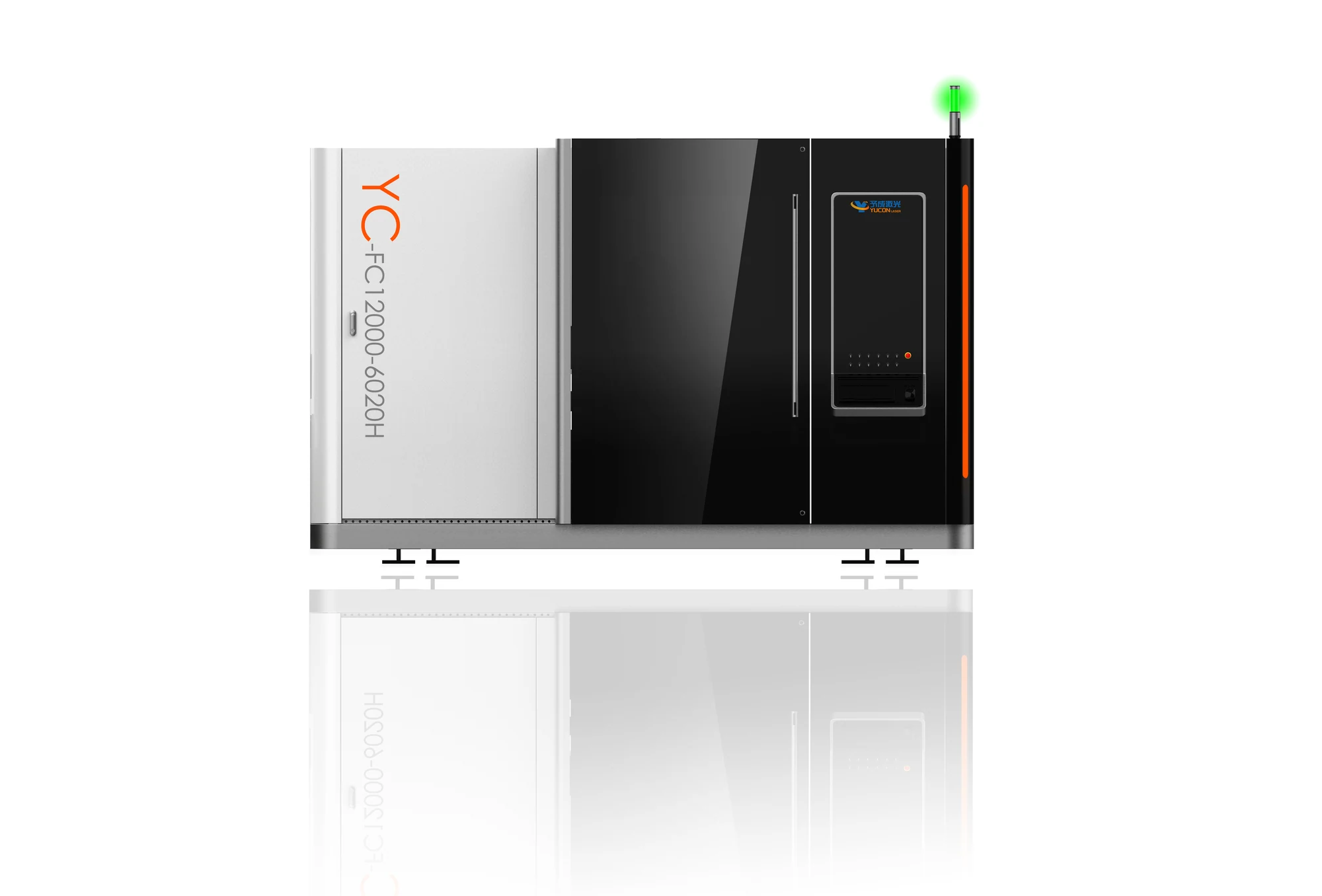
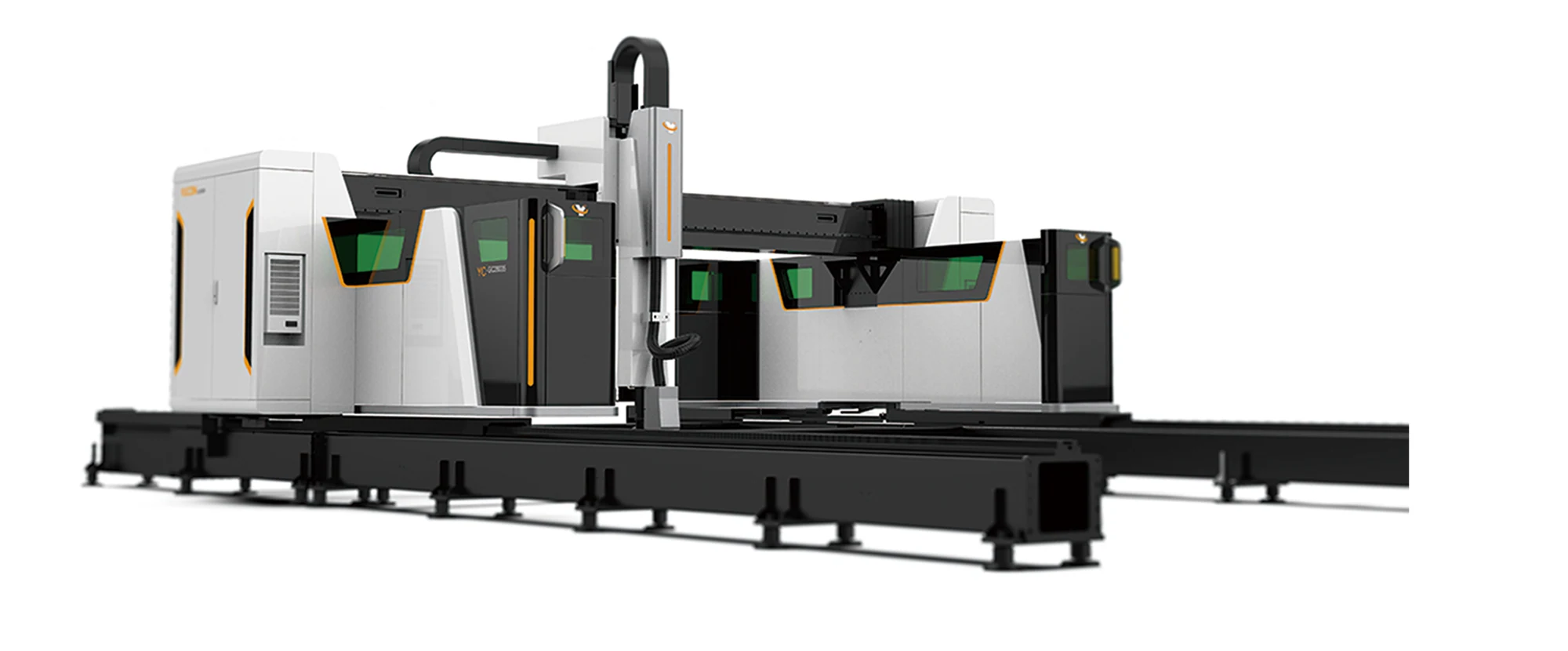
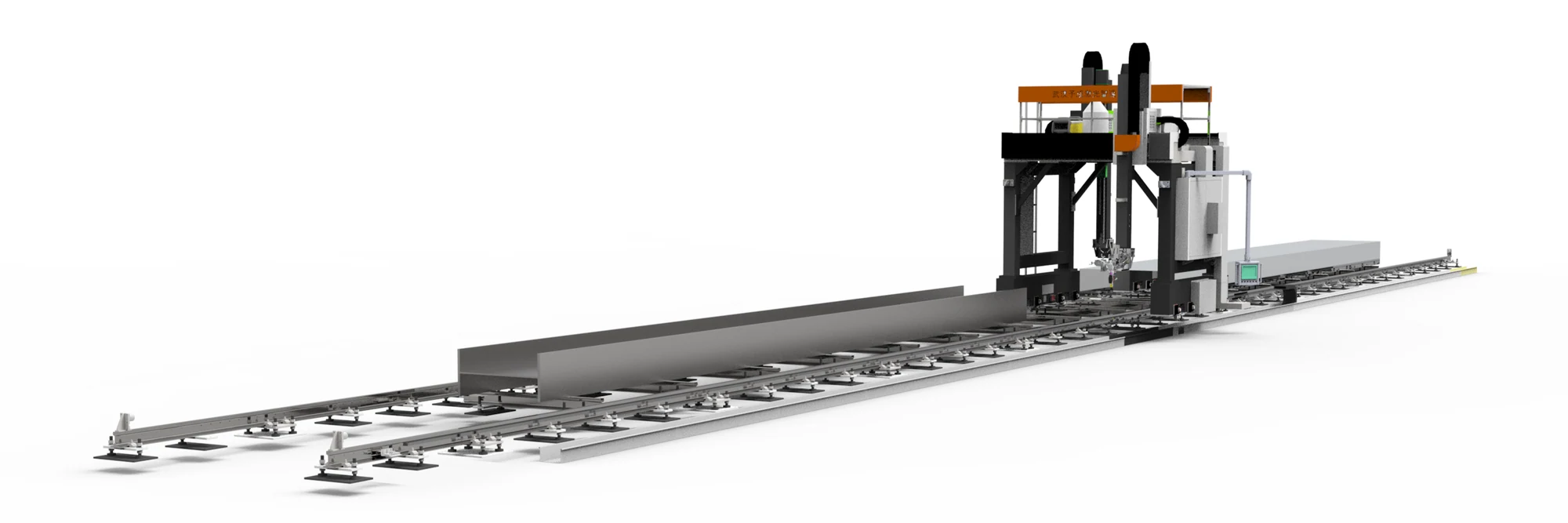
Cutting and welding coordinated on one flow.
Teach-free automation for fillet welds.
Section and plate blanking in one installation.
Based on a typical box column application (400 × 400 × 12 000 mm, 14 mm wall).
| Parameter | Specification |
|---|---|
| Laser power | 20 kW |
| Suitable products | H-beam, box column and similar |
| Max. welding thickness | single side ≤ 16 mm · both sides ≤ 30 mm |
| Welding speed | ≥ 1.6 m/min |
| Max. welding length | 24 000 mm |
| Repeat positioning accuracy | ≤ 0.1 mm |
| Welding head | Fully water-cooled reflective (copper-based optics) |
| Lens service life | > 5 000 h — about 3× conventional |
| Light utilisation | > 99.8 % |
| Power stability / focal drift | < ± 1 % / < ± 0.05 mm |
| Process features | No groove · single-pass full penetration |
Laser-arc hybrid welding (LAHW) combines a fibre laser and a gas-shielded arc in one process. The laser stabilises the keyhole while the arc pre-heats and widens the joint, giving deep penetration with far greater tolerance to fit-up than laser welding alone.
For web or plate thickness up to 16 mm, no groove is required: the line welds from one side and forms a full-penetration bead on both sides in a single pass. Above 16 mm a small Y-groove is used, with the hybrid root pass filled by GMAW or SAW.
Typically 1.5–2.2 m/min, around 3–5× faster than submerged arc or gas-shielded arc welding. Tracking speed is up to 2 m/min with accuracy better than 0.02 mm.
Single-side welding to 16 mm and double-side welding to 30 mm. It handles H-beams (web 200–4000 mm), box columns (200–1500 mm), precision steel, T-beams and U-rib bridge decks, in lengths from 1200 to 20000 mm.
Yes. Third-party tests on Q235, Q355B, Q355NE, SN490B and S690 samples returned Grade 1 ultrasonic and X-ray results, tensile strength above the base-metal requirement and 180° bend tests with no cracks.
For a 100 t box-column run, reference data show about 15,872 CNY of welding cost versus 53,455 CNY for GMAW/SAW — roughly 70% lower, driven by no groove, 73% less wire and far fewer shifts.
Provide your joint configuration, material grade and plate thickness. We will run the coupon on our application line, section it, and report penetration, hardness and mechanical results alongside a full line quotation.