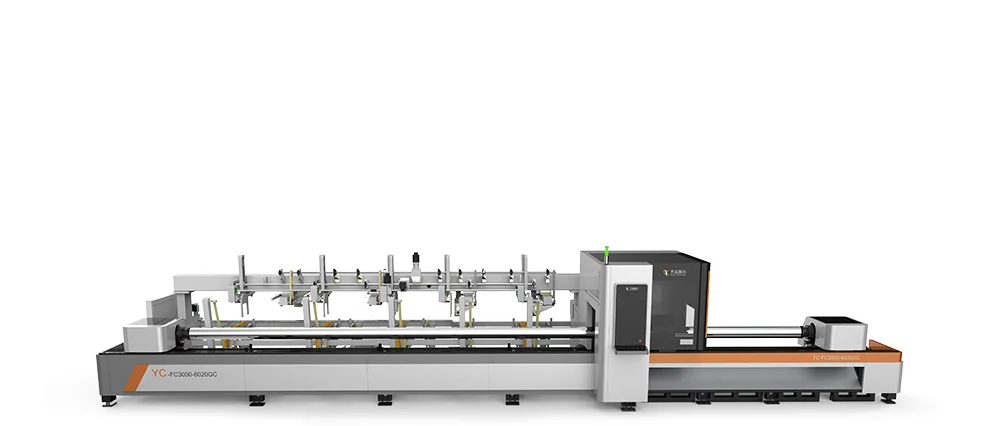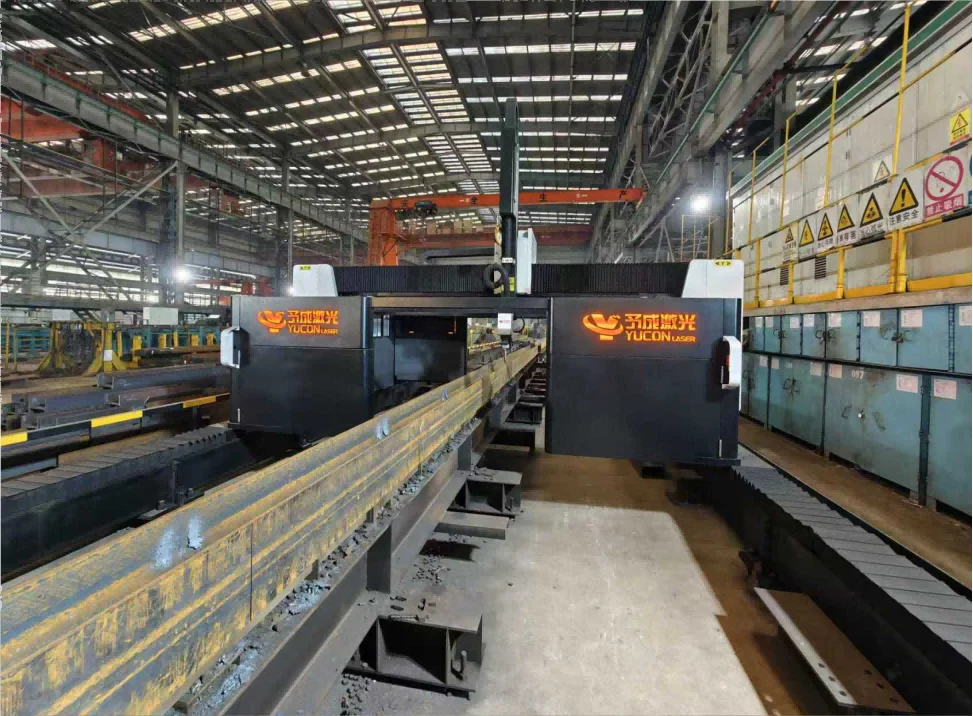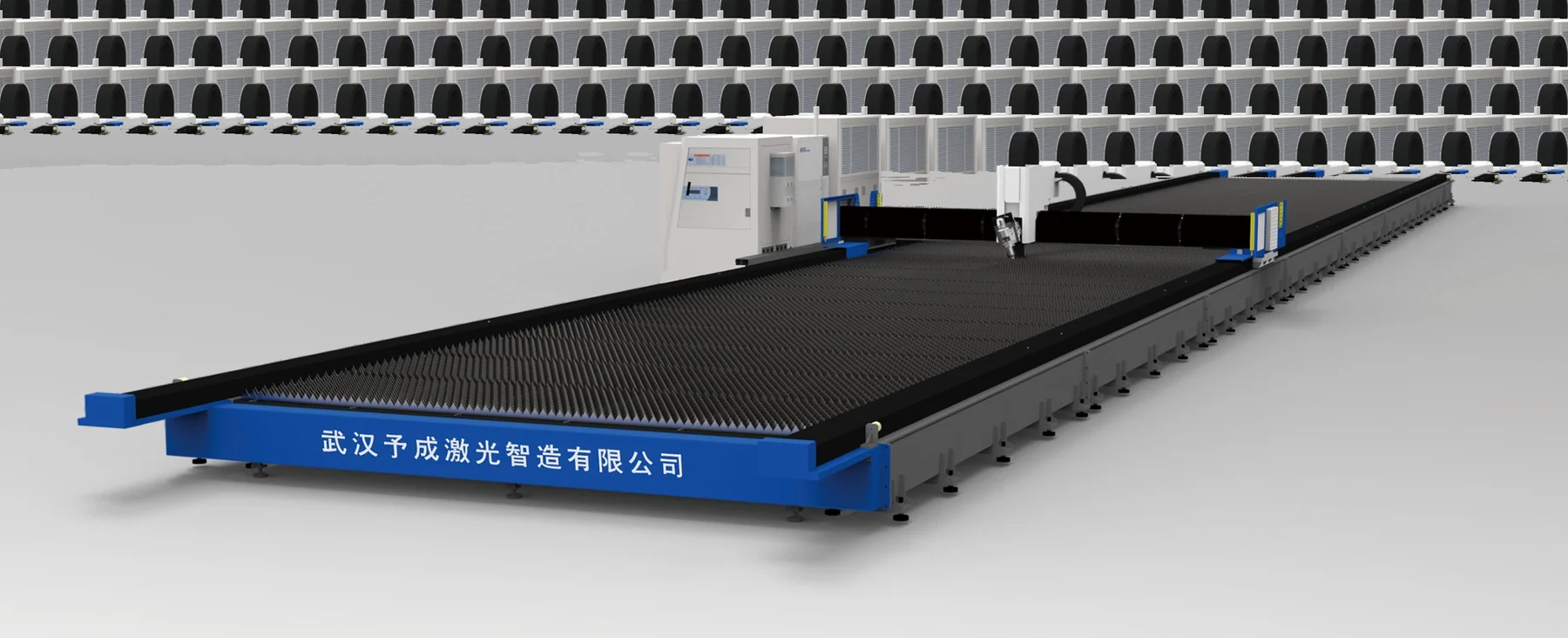
On the eighth day of the first lunar month, the festive atmosphere still lingered across Hubei. Reporters entered the production workshop of Wuhan Yucon Laser Intelligent Manufacturing Co., Ltd.: red couplets were posted at the workshop entrance, the production schedule was covered with labels, new order figures kept rising in real time, and workers threw themselves into production with full enthusiasm—a vibrant scene of "starting work at a sprint and beginning the race at full speed". Outside the workshop, a laser cutting machine customized for Jingye Group was being loaded onto a truck, bound for the customer's site. Customers had come to sign orders on the seventh day of the lunar year; the bustling orders early in the new year are the best proof of this laser intelligent manufacturer's solid technical strength.
What happened
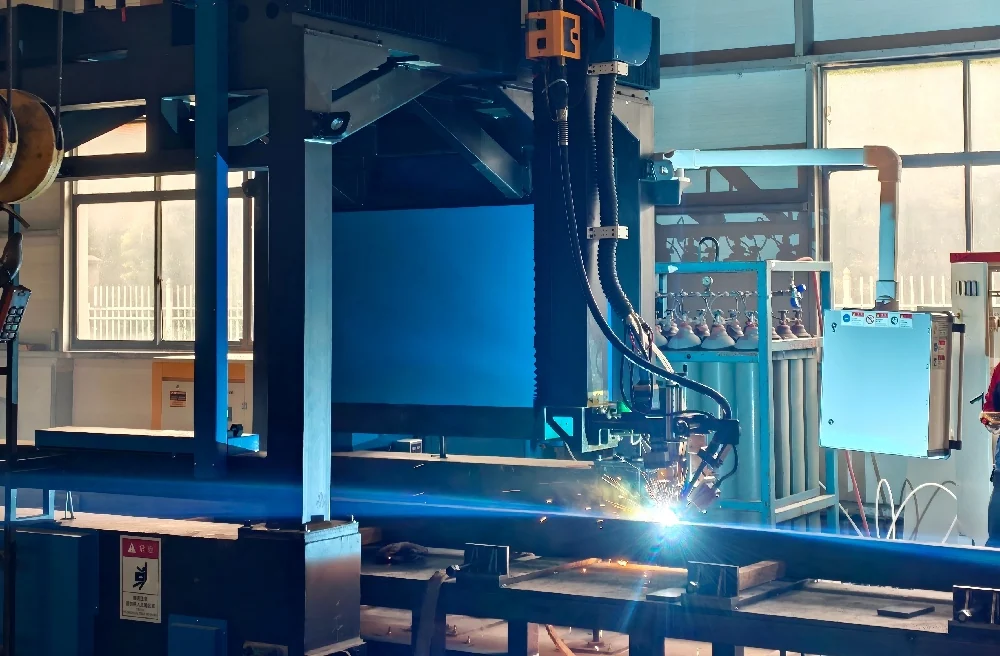
Inside the production workshop, a 3D five-axis laser cutting machine was demonstrating H-beam cutting. The laser cutting head, like a nimble fingertip, moved precisely along the complex H-beam cross-section under programmed commands; amid the sizzling cutting sound, sparks streamed along the steel plate edge, scattering fine light particles that vanished in an instant. Cutting work that previously required multiple processes and several people now achieves cutting, grooving, and hole drilling in one machine; thick steel plates are effortlessly carved under the laser's sharp sword.
"H-beams have complex structures and variable cross-sections. Conventional flame cutting is not only inefficient but also requires secondary grinding and straightening. Our equipment achieves one-shot forming through a high-precision control system and a self-developed optical path structure," said Zou Yujing, Chairman of Yucon Laser. Behind this lie industry challenges such as focal stability under high-power lasers and equipment adaptation to workpiece deformation. "What we build is not just a machine, but leadership in steel-structure cutting process standards."
The customer production daily shows an impressive scorecard: compared with conventional processes, Yucon's 3D five-axis laser cutting line raises production efficiency 3–4 times and improves material utilization by over 15%. This breakthrough stems from two core technology innovations: process intensification completes cutting, grooving, and hole drilling in one operation, greatly reducing reliance on labor and auxiliary equipment; thermal deformation control draws on the laser's high energy density and small heat-affected zone to substantially reduce post-cutting deformation, eliminating the straightening step essential in conventional processes. From "multiple processes" to "one-shot forming", laser technology is reconstructing the production logic of steel-structure manufacturing.
As a company deeply engaged in the laser industry for years, Yucon Laser has long held a firm position in steel-structure laser cutting. Its R&D team accounts for over 35% of headcount; it holds 21 invention patents, 15 utility model patents, and 6 computer software copyrights, and is recognized as a high-tech enterprise, a specialized and innovative SME, a gazelle enterprise, and an AAA tax-credit enterprise. Its self-developed 3D five-axis laser cutting production lines have been deployed in more than 500 sets across the steel-structure industry, ranking first domestically in delivery volume.
With outstanding system stability, complete functions, and high cost-performance, its equipment has become the preferred choice of leading domestic and international enterprises including China Construction Steel Structure, China Huadian, CRRC, Honglu Steel Structure, and Hangxiao Steel Structure. Many customers place repeat orders, keeping Yucon's performance first in the industry.
After becoming the leader in steel-structure 3D five-axis cutting, Yucon Laser did not stop there. In serving customers, Zou Yujing found that welding in major national engineering fields such as steel structures, nuclear power, and ships has long suffered from smoke and dust, low efficiency, insufficient precision, and high labor costs—precisely where laser automated welding can deliver. "We decided to move from the 'red ocean' of laser cutting to the 'blue ocean' of laser welding. Rather than follow foreign technology, we open a new track, using laser-arc hybrid welding to solve the industry's bottleneck problems."
Technology and performance
Behind this transformation lies deep industry-university-research cooperation between Yucon Laser and Professor Gao Ming's team at HUST, a rigorous effort to convert frontier academic ideas into engineering practice. The company pioneered a fully water-cooled reflective laser head, solving the stability problem of high-power laser heads in harsh industrial environments. Replacing traditional lenses with high-reflectivity copper-based mirrors (reflectivity >99.8%), combined with multi-stage water cooling, it achieved the first engineering application of a 20 kW-class reflective laser welding head, filling an industry gap. This welding head's lens life exceeds 5,000 hours, over three times that of conventional technology.
To make the equipment more intelligent, Yucon Laser equipped it with "eyes" and a "brain": CBD vision, laser ranging, and spectral analysis collect weld and molten-pool data in real time; multi-sensor data fusion, analyzed through AI algorithms, realizes real-time weld seam correction. This innovation transforms Yucon Laser from a pure equipment manufacturer into a true technology leader in laser welding processes. Its H-beam/box-column laser-arc hybrid welding production line achieves high-speed welding with low heat input and low element dilution, raising efficiency 3 times versus conventional processes; it enables single-pass one-shot forming without grooves, supports all-position horizontal and vertical welding, and perfectly adapts to long straight-seam welding needs, breaking down barriers and thresholds for steel-structure enterprises.
In nuclear power, a field demanding ultimate welding precision and reliability, Yucon's technological breakthroughs further demonstrate the strength of Chinese intelligent manufacturing. Pure stainless steel pipes for nuclear power long depended on imports at a cost of RMB 120,000 per ton. Yucon's laser-arc hybrid welding production line has enabled domestic stainless clad pipes to be promoted in the nuclear power sector; by replacing imported pure stainless steel pipe, the cost dropped to RMB 25,000 per ton, an 80% reduction, with performance fully meeting the extreme nuclear environment requirements, and the pipes have been applied in national major engineering demonstration projects.
Industry significance
Once, to crack the nuclear stainless clad pipe welding problem, Yucon's technical team worked continuously for 72 hours, starting from the detail of how the material surface oxide layer affects arc stability, revising process parameters overnight and optimizing the optical path structure, until the first perfect weld was laid at 3 a.m. "At that moment everyone fell silent—not from exhaustion, but from emotion, and from a sense of responsibility behind the technological breakthrough for major national projects," Zou Yujing said, his words full of conviction and dedication. Today, Yucon Laser also leads the drafting of the country's first Code of Practice for Laser-Arc Hybrid Welding of Stainless Clad Pipes (Plates), filling an industry standard gap.
On this new journey in the new year, Yucon Laser's innovation never stops. Zou Yujing revealed that the company will continue to deepen "laser + arc" hybrid welding technology, extend into dissimilar-material welding such as titanium-steel and aluminum-steel, and solve more welding challenges in high-end manufacturing; it will also lay out next-generation smart factory technologies such as digital twins, advancing metallurgical steel-structure production lines toward unmanned, intelligent operation. On the market side, having served more than 500 industry-leading enterprises, Yucon will focus this year on expanding applications in major national engineering fields such as nuclear power, offshore engineering, and bridges, injecting more momentum into the high-quality development of Chinese manufacturing through laser intelligent manufacturing.
From laser cutting to laser welding, from equipment manufacturing to process leadership, from following and imitating to independent innovation, Yucon Laser's development path is a microcosm of the breakthrough and upgrading of China's laser manufacturing industry. Laser is no longer merely the "fastest knife" for cutting metal; it has become a "smart brain" with perception, analysis, and decision-making, deeply integrated with AI and digital twins, driving metallurgical manufacturing from "experience-driven" to "data-driven". With innovation as the brush and technology as the ink, Yucon Laser is painting a vivid picture of Chinese manufacturing advancing toward Chinese intelligent manufacturing on the canvas of new quality productive forces.
Reporter: Wang Zhi; Correspondent: Zou Fengming.
Original source
Reporting: China Metallurgical News / Metallurgical Media · First published 2026-03-02. The article above is an English translation of the cited report.
Frequently asked questions
What was demonstrated in the workshop?+
A 3D five-axis laser cutting machine cutting complex H-beam cross-sections, alongside laser-arc hybrid welding lines.
Why is five-axis cutting important?+
It allows cut-off, bevel, holes and marking on all faces of a beam in one setup.